The Digital Brand Tree. Part 1. May 2026
This is part one, of three companion briefs to the thesis “The Digital Brand Tree.”
See also 2: Signal records, governance and technology · 3: The beneficiaries of an antifragile digital brand.
We are in a time of exponential change, and so on. We know the meme. We know it’s true, that we need to move fast to even keep up with the bare minimum of change. We also need to face what we could (and are losing) as we get caught up in the speed. This is not a new challenge, but it is under increasing pressure as the speed continues to bring new, unmanaged opportunity.
Brand is struggling. And not just because brands are being rapidly homogenised and commoditised. The operating surface of a brand is much more complex than it was some years ago, mostly thanks to the exponential complexity brough by digital. And yet, so very many organisations have never established their digital brand. The safe bet is a stale ‘everyman’ web presence, brochureware with a selection of product and service, annual reports and links to a couple of social media channels. Or for retail, it’s a few campaign banners and a warehouse of inventory and small carousels. The most common theme being that digital is a sales and distribution channel. Somewhere to attract customers and sell to them. And in practice, to divide responsibility for success across marketing, technology, and a slightly amorphous digital function. All of these are correct, but limiting. In reality, the digital footprint is an organisation’s largest customer-facing operating surface, and as a result, often overwhelmingly unwieldy. It’s also an area that is most at risk at this time of speed and change. Customers, expectations and capability are changing faster than teams can keep up.
At stake is the promise of a brand filled with purpose and ambition that is coordinated, consistent and change-enabled. The reality is different, because that’s how reality works, and we choose smaller challenges to tackle, so we can hit KPIs by accepting process gaps and wallpapered disconnections. A singular brand ecosystem is a challenge that is easy to ignore as too complex to fix. Too Transformation-reliant. But I don’t think so. I’m not a particular fan of big ‘T’ Transformations. They’re too unwieldy, and drawn out processes that get outdated very quickly. Adaptive transformations have small ‘t’s, and are much more nimble and capable.
I’m proposing a distinct way of thinking about the digital brand operating surface, and introducing a model that organisations can use to build more responsive, governable operations. This is a model built up over my years of watching, and inhabiting, organisations that have had divisions in digital and brand ownership, over the natural ebbs and flows of business. Awkward last minute conversations about domain registrations, risk and why a campaign can’t go live. Or a social media channel that seems to be managed by a junior marketer at last year’s agency of choice, that still seems to get more likes than the main brand.
The problem the model solves is fracture.
The problem the model solves is fracture. Because digital is filed inside other functions, ownership splits and process becomes a drag rather than driver. Not ironically, the operational enabler needed is governance, which is usually seen as part of that drag when it comes to delivering value, and resented as a necessary evil. As an enabler, governance helps us work through the fractures, because governance is focussed on providing clarity of decision making and ownership.
As is often said lately, AI has accelerated the market. Agentic change has added new challenges because it preferences speed and efficiency over quality and governance, which is deepening fractures by papering over depth with shallow expertise. We’re seeing a strong shift as more governments and experts focus on explainability and operability over raw efficiency, and there is an early opportunity to build governance into agentic systems while controlling the frameworks around it. The success of this needs a strong framework model to provide the comfort of stewardship to support and enable operational success, without being too prescriptive or forcing Transformation.
There is an opportunity lost by staying in the ‘do-nothing’ current state of being ungoverned. Some of this is through the opportunity cost of treating it as a limited-focus channel and ignoring the broader necessity of digital within a customer’s life. More directly this is through opportunities lost, as damage to the digital operating surface becomes a cost paid in lost trust, engagement that erodes the effectiveness of the brand, and lost customers.
In April 2026, the ShinyHunters group took the Canvas educational platform to the global front pages, with a successful breach that yielded up to 275 million user records spread across over 8000 educational institutions globally. An attempted security fix by Instructure (owner of Canvas) resulted in ShinyHunters breaching Canvas a second time, placing ransom notices on many university sites, and sending scam emails to many students. In the end, Instructure came to an ‘agreement’ (ie, paid the ransom) with ShinyHunters to destroy the data, and allow them to recover their systems.
Many customers and institutions complained about the lack of transparency and communications from Instructure. The end result has heavily damaged trust in Instructure and Canvas, with a number of governments launching investigations, and a class action launching in the USA. Many organisations will continue to pay this price at different scales, because the fractured surface is too unwieldy to negotiate.
That’s the cost of bad governance. But a brand’s customers are not interested in the details of internal ownership of systems and governance. They see one brand and trust/failure is funneled through that brand. For a customer, it’s a short step between a breach, and the communications to keep them informed and feeling safer. But for many organisations, it’s a surface fractured by an earthquake event like a security incident. By solving fracture, we have a cleaner, stable and more antifragile operational surface.
By solving fracture, we have a cleaner, stable and more antifragile operational surface.
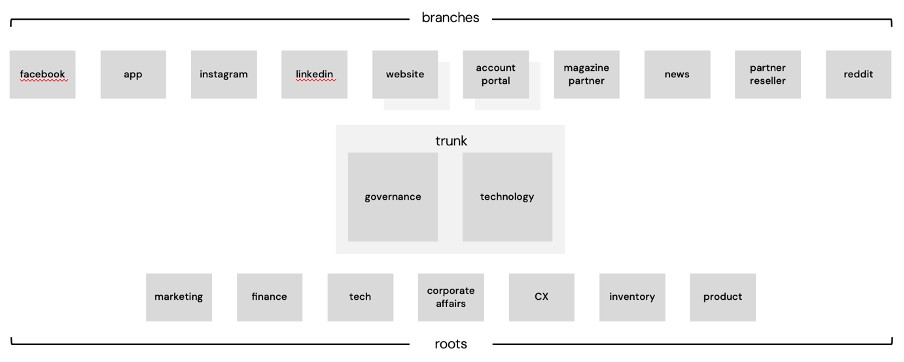
There’s a key visualisation in this model: the organisation is a tree. The roots are the organisation’s divisions (for example: technology, product, risk, marketing). These are the anchors of an organisation, rooting the organisation in an industry or place, but also as the deep strengths where product and value is produced. Visually, each division can be a root – some are more heavily evolved than others, and some organisations have a complex root system with divisions, teams and resources spread across the globe. Even agencies and vendors can be included.
It’s important to realise that roots can die, or be cut off, and doing so should not threaten the entire tree. New roots can grow, too, just like an orgnisation develops over time. This concept will apply throughout this thesis, as it’s designed to continually evolve with an organisation.
Next, move to the top of the tree. The branches are all the channels and touchpoints that reach between the organisation and its customers. These can be sales, marketing, brand, government/regulators, or even (and importantly) fraud and criminal. And just like a tree, there are a myriad of branches, sometimes too many to count or realise that they are present. The majority of organisations end up in a place where they have no idea how many places their brand is encountered; whether on Reddit, review sites, news and media, social media pages for a long-gone campaign, or a social channel that claims to be from the ‘team’.
There is also a schema for making sense of the branches. A branch is owned by a division – marketing might own a social channel, technology a portal, but ownership is not the same as what the branch is for, or how the brand comes to appear on it. For that, the branches are mapped against three classifications: owned, earned and paid. Owned branches are directly controlled; paid branches are where a cost exchange determines the brand’s visibility; earned branches are where the brand appears without an exchange it controls – social commentary, reviews, and, less comfortably, scam and impersonation. A single platform can sit across classifications, social for example mixes paid and earned engagement. Mapping the classifications becomes important when we get the part that makes a tree…a tree.
That being the trunk, the majestic connection between roots to branches, and is the “why” and the “how” that a tree comes to life. Connecting the output of the roots to the branches, and bringing back that sunshine to the roots. Organisationally, the trunk is a combination of governance (the “why”) and technology (the “how”) operations that connect production (the roots) to performance (the branches), and the layer that filters the noise of channel data into the classifications and signals that the business actually needs to act on.
The tree becomes a surrounding framework around the fractured ownership challenge for which function owns digital. With a framework that builds a single ecosystem, it supports ownership gaps with patterns of behaviour and connection. By establishing the pattern that social media is registered to agency relationships owned by marketing and brand, the organisation establishes the analytics and performance, target customers and how the channel is used, and why it’s useful. This is a pattern for connection, that flows insights from customers to internal teams, and from teams to customers. The governance filters this noise both ways, and the technology pulls the insights into the teams, and pushes the product and comms back out.
A steward function lays a framework over the whole tree
It does this through stewardship, not reorganising ownership. Existing remits stay where they are; a steward function lays a framework over the whole tree, making the connections between owners visible through a robust RACI, and closes the gaps.
What happens is that the digital brand operating surface acts like a tree. The roots produce material of value (content, product etc) that goes through the governance filters and processes, enabled by technology, to the branches to connect with customers. In turn, the branches collect and send data (about customers, performance etc) back through the trunk, where governance filters the noise into key signals, and the technology operations send the signal records to the roots to both inform decision making, and enable the next round of production.
As an application, the tree is built on agents, performing the activities to push and pull from roots to branches, and back again. Built on the governance intelligence, and powered within the technology, these agents are part of the model stewardship. It’s that model stewardship that is essential to maintain the authority and agency of the tree, by taking action and also being transparently explainable because of the authority of the governance model. The stewardship is both the enabler, and the auditor because it informs the agents, while enabling the agents to drive the model.
The benefit is an antifragile organisation: one that protects itself, produces with intent, and earns customer trust by design rather than by accident.
In the following 2 articles, I’ll dig deeper into how the trunk operates under the framework of the steward, who benefits and how it builds that antifragility. To finish for now, here’s a v1 example of the tree model.
AI note: This work was created with the assistance of AI. Claude Opus 4.7 to be exact, which was prompted to ingest multiple drafts and transcripts of my voice notes, as part of an overall project on this topic, then create a single thesis as well as 3 shorter articles (1 for each section of the overall thesis), after which it was prompted to tweak the sections at least three more times. I’d give it a 6 out of 10 for the work it did in creating this particular shorter article – a good start, particularly in using language that ‘sounds’ like me. However, I had to rework most of the sentences, and add a few additional paragraphs. The visual itself is human-crafted.

